
A producer is more than a name on a funding application: the right collaborator can help shape a project and guide it towards production. Finding a producer for a short film in the UK starts with watching shorts that share your film’s tone or ambition, then researching the people and companies behind them. Meet potential collaborators at festivals and industry events, follow their work, and make a thoughtful, personal approach. You can attend a film festival without submitting a film.
It’s understandable to focus first on the script or the budget, but a producer can contribute to the creative direction as well as the practical demands of getting a short made. The aim isn’t to contact everyone; it’s to find someone whose work, working style and interests align with yours. This guide shows how to identify suitable producers, where to meet them, how to research their credits and build a concise contact list, then how to start a conversation that feels specific to your project. It also covers what to discuss before deciding to work together.
Key Takeaways
- Use festivals and industry events to build genuine connections, then follow up with a brief, personal message.
- Trace the credits of comparable UK shorts to identify producers and companies whose experience fits your project.
- Keep a focused contact list with each person’s work, contact details and a clear reason for reaching out.
- Approach a producer as a creative collaborator and discuss working expectations before committing to the project.
1. Meeting producers at festivals, networking groups and events
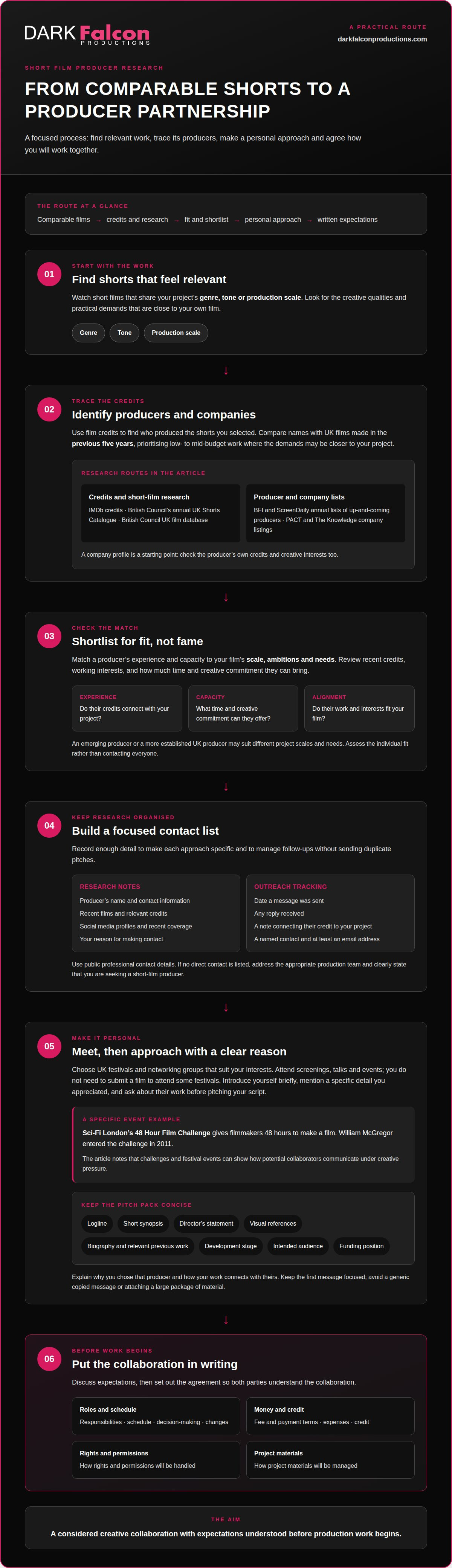
Film festivals offer useful opportunities to meet producers, even if your short isn’t on the programme. Attend screenings, talks and networking events with a clear introduction to your project. Note the names of producers whose work interests you, then follow up with a specific message about a film you saw. If you missed their screening, a sincere congratulations can still open a conversation.
Use festival awards and programme credits to identify producers behind films that share your subject, tone or scale. A director’s award-winning short may lead you to a producer whose experience fits your ambitions. Explore festivals and film networking groups across the UK, and choose events that suit your interests rather than trying to attend every gathering.
Some festivals welcome industry guests and filmmakers without requiring a film submission. You can attend to watch work and meet people while your own project is still in development. Keep the two routes separate: submit when a festival suits your film, and attend when its programme or networking opportunities are relevant.
For a practical example, Sci-Fi London’s 48 Hour Film Challenge gives filmmakers 48 hours to make a film. William McGregor entered the challenge in 2011. Challenges and festival events let you observe how potential collaborators communicate under creative pressure. After a screening or session, introduce yourself briefly, mention a specific detail you appreciated, and ask about their work rather than immediately pitching your script.
Choose between an emerging producer and a more established UK producer by matching their experience and capacity to your project’s scale, ambitions and needs. Review their credits, then discuss how much time and creative commitment they can bring.
Put your producer agreement in writing. Cover responsibilities, schedule, fee and payment terms, expenses, credit, and how rights and permissions will be handled. Set out how decisions, changes and project materials will be managed so both parties understand the collaboration before work begins.
2. Researching producers through IMDb and industry lists
Start with short films that share your project’s genre, tone or production scale. Use IMDb credits to identify their producers and production companies, then compare those names with UK films made in the previous five years. Prioritise low- to mid-budget work, whose creative and practical demands may be closer to your own than those of a large feature.
Useful UK research routes include the British Council’s annual UK Shorts Catalogue, which offers an overview of people producing short films. Its UK film database also includes completed shorts, whose credits can lead you to producers and companies. The BFI and ScreenDaily publish annual lists of up-and-coming producers, providing further names to investigate.
For company research, the UK Government identifies PACT and The Knowledge as media business listings where you can search for UK film and television companies. Use them to find organisations whose work aligns with your film, then review recent credits and the people behind them. A company profile is only a starting point: check the producer’s own record and creative interests before making contact.
A useful pitch pack gives a producer enough detail to assess your idea and its fit. Include a logline, short synopsis, director’s statement, visual references, your biography and relevant previous work. Add the project’s development stage, intended audience and funding position, keeping everything concise and specific to that producer.
Useful organisations and networks include the British Council, BFI and BFI NETWORK, alongside PACT and The Knowledge for company searches. BFI NETWORK supports writers, directors and producers at the start of their filmmaking careers, making its activity relevant to emerging collaborators.
Before sending an application or pitch, explain why you chose that producer and how your work connects with theirs. Avoid a generic copied message. If you’re shaping a short for production, creative development for short films can help clarify the project’s direction.
3. Using freelancer databases to find producer contacts
Freelancer databases can help you identify producers by role, location and credits. Search for people who have worked on shorts or related productions, then compare their public profiles with your script’s needs. Treat a profile as a starting point, not a complete picture: look for recent projects and use the professional contact details listed for their production company.
Film schools and producing-course alumni offer another route. Explore public alumni profiles, course showcases and graduate networks to find producers building experience with short films. A tailored message can mention a particular project or interest, explain why you’re reaching out, and ask whether they’re open to discussing creative collaboration. Keep the first approach focused rather than attaching a large package of material.
When recording production company or sales agent contact details in a database, include a named contact and at least an email address. Use public company contact information and identify the relevant person before sending a pitch. If there’s no direct contact listed, address your message to the appropriate production team and clearly state that you’re seeking a short-film producer.
A producer-research spreadsheet keeps outreach organised and specific. Record the producer’s name and contact information, recent films, social media profiles, recent coverage and your reason for making contact. Add a status column for the date you sent a message and any reply, so you can manage follow-ups without sending duplicate pitches. In a separate notes field, connect a credit to your project, such as a shared genre or approach to storytelling.
Watch for warning signs before sharing your script or agreeing to work together. Pause if someone promises guaranteed funding or distribution, pressures you to pay for vague services, or avoids discussing responsibilities and rights in writing. Check that their public credits align with their professional identity, and document key conversations and agreed terms.
4. Finding short-film producers
Where can you find a producer for a short film in the UK? Start with completed shorts that resonate with your script, then identify their producers through credits and production-company profiles. Film Hub North recommends researching producers’ work and social media to assess whether their interests fit your project.
Look beyond short-film credits alone. Experience in theatre, music videos, short documentaries, commercials, festivals or events can build transferable producing skills. For example, a producer with event experience may bring useful knowledge of schedules, teams and practical coordination. Focus on the work they’ve made and the perspective they could bring, not just their job title.
Follow potential collaborators on social media and engage thoughtfully with their posts. Instagram and Facebook groups can help you find people working on shorts and smaller productions. Search relevant hashtags, such as #shortfilmproducer or #ukfilmmakers, then review each profile before reaching out. A meaningful comment about a specific project is a stronger start than a generic pitch.
Make contact purposeful. Briefly introduce yourself, describe the kind of films you make and explain why you’re approaching that producer. Film Hub North advises treating a producer as a creative collaborator, rather than simply asking them to produce a film. Build familiarity before raising your own project, and be clear about your intentions if you’re contacting them around a funding opportunity.
Discuss expectations before agreeing to work together: availability, work ethic, creative tastes, values and the time each person can commit. Look for someone with the energy and perseverance to bring the project to fruition, and whom you’d want to work with again, not only to complete a funding application. BFI NETWORK supports writers, directors and producers at the start of their filmmaking careers; Film Hub North’s Creative Producer School and Film Hub South West’s Producer Lab also develop emerging producers.
For a short film, the next step is to turn a promising conversation into shared creative work. Develop your short-film idea with a clear sense of its story, audience and production direction.
Dark Falcon Productions: Creative
Dark Falcon Productions provides creative support and short-film production for filmmakers ready to develop an idea into a screen project. Turn to the team when your concept needs a clearer creative direction or you’re preparing to shape a short for production.
Finding a producer is only part of the process; your project also needs a strong creative foundation. Sharpen the story, define the film’s intended tone and audience, and consider how each scene serves the central idea. These decisions give your short a focused starting point for development.
Ready to move your short film forward? Contact Dark Falcon Productions to discuss your project.
Shape your next step into a clear creative direction
Finding a producer for a short film in the UK is one part of moving an idea towards production. Decide what you want the project to become, which creative choices matter most, and what kind of collaboration will help you develop it. A focused conversation can bring those priorities into view.
Dark Falcon Productions offers creative development, short films and social media management. These services can support different stages of a project’s creative journey, from developing a short-film idea to considering how its work reaches an audience. Choose the support that fits your current stage and goals.
Share where your project stands and what you’re working towards. Contact Dark Falcon Productions today to discuss your creative project. A considered next step can give your short a stronger direction.
Frequently Asked Questions
Why do I need a producer?
A producer helps turn a film idea into a project that can be planned and delivered. They can help develop the concept, organise practical decisions and bring creative collaborators together, while the director leads the film’s creative vision. For example, a producer can help assess whether the locations, cast and schedule for a scene support the story. The role is collaborative, not a substitute for the director’s creative decisions.
So what’s out there?
UK short-film producers work across a range of formats and backgrounds. Some focus on shorts, while others bring experience from theatre, documentaries, music videos, commercials or events. BFI NETWORK supports emerging writers, directors and producers, and programmes such as Film Hub North’s Creative Producer School help build producing experience. Look for the collaboration your project needs rather than assuming every producer follows the same route.
Will I need to find funding?
Funding needs depend on the project’s resources and production plan, so discuss your approach with a prospective producer early. Funding routes can include grants, crowdfunding or other project support. The Short Film Fund England expects a writer, director and producer to demonstrate a creative track record, which may come from film, television, documentary, theatre or other art forms. Crowdfunding also takes sustained work on campaign strategy and delivery.
How do I approach a UK film producer with a short film idea or script?
Send a concise, personal introduction that explains who you are, what you make and why you chose that producer. Share a logline and short synopsis, then ask whether they’d be open to discussing the idea. For example, refer to a specific choice in one of their films and explain how it connects with your project. Avoid copied messages to multiple producers, and don’t attach a full script without a relevant reason.
How can I find a producer through UK film schools and regional film hubs?
Explore film-school showcases, alumni networks and producer-development programmes to find emerging collaborators and learn about their work. Film Hub North’s Creative Producer School and Film Hub South West’s Producer Lab develop emerging producers. BFI NETWORK brings together the BFI, national film organisations and cultural venues across the UK to support writers, directors and producers at the start of their careers.
What does a short-film producer do, and how much time do they typically commit?
A short-film producer helps progress the project through development, planning, production and delivery, coordinating practical needs with the creative team. Their time commitment follows the work involved at each stage, including preparation, shoot days and post-production. A UK producer’s shoot day is 11 hours, including one hour for lunch. Discuss availability, responsibilities and the expected schedule together before agreeing to work on the film.