
The best answer to in-house vs agency for social media management is often a hybrid: keep brand knowledge, daily engagement and approvals close to the business, while bringing in agency expertise for strategy, creative development or specialist support. An in-house team offers direct oversight and a close understanding of the company; an agency brings an external perspective and a broader mix of skills. Either model can work, but unclear ownership can lead to duplicated work or conflicting direction.
Before deciding who should manage your social channels, weigh control, expertise and capacity. The right arrangement depends on your goals, the content you need and the time your team can commit.
This guide explains what in-house and agency social media management involve, where each approach has strengths and limitations, and how a hybrid team can divide the work. It also covers how to align strategy, creative responsibilities and approvals so campaigns stay coherent.
Key Takeaways
- Compare the full demands of an in-house team with the breadth of expertise an agency can bring, not just the headline cost.
- Use clear ownership for strategy, content, approvals and reporting when internal marketers and agency specialists collaborate.
- Watch for conflicting briefs, duplicated work and inconsistent messaging when strategic decisions are split across teams.
- Build a hybrid model around your needs, assigning day-to-day engagement and specialist campaign work deliberately.
- Choose the arrangement that fits your goals, creative workload and internal capacity, then agree how success will be measured.
What Is In-House vs Agency Social Media Management?
In-house management places social media within your organisation; an agency provides outsourced support. The difference affects employment costs, access to specialists, creative control and how work is commissioned.
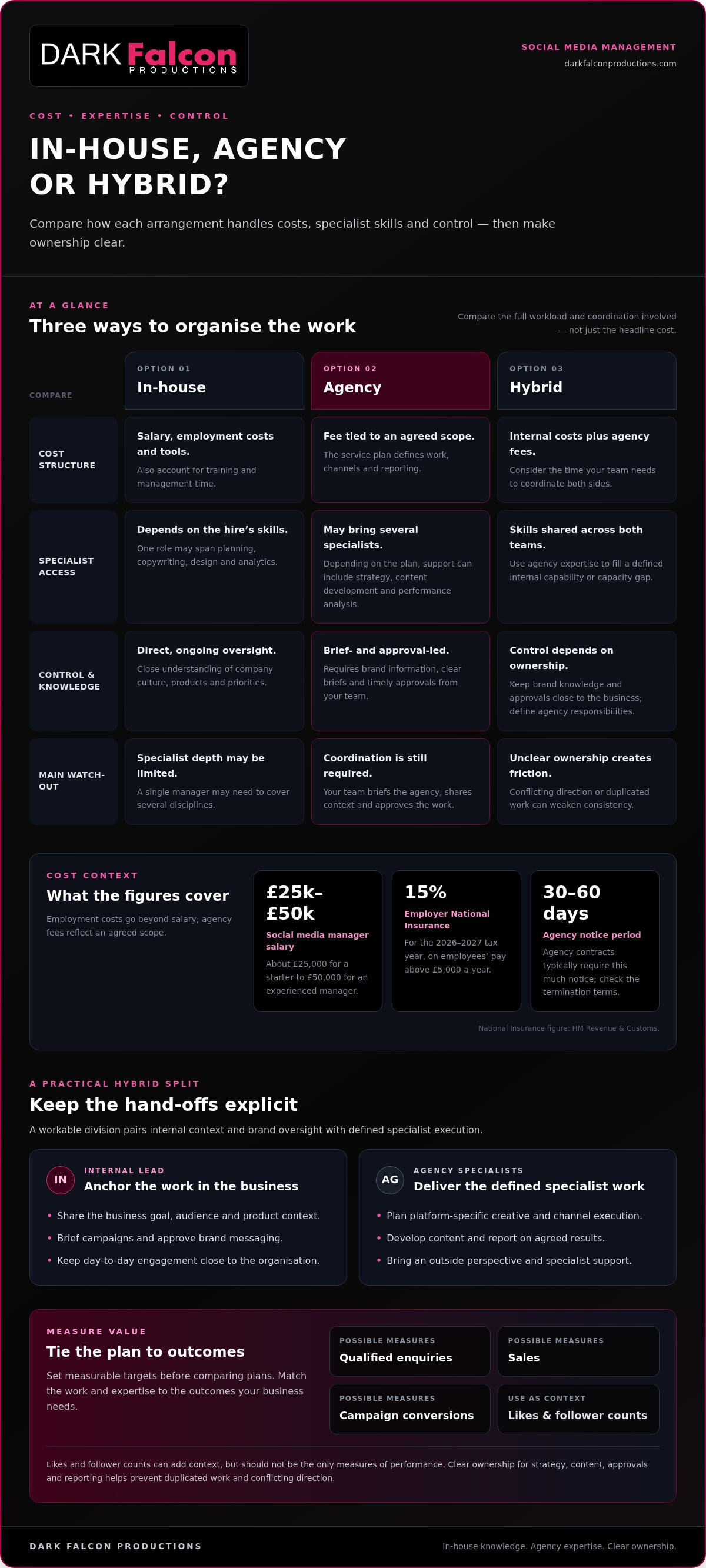
When hiring a social media agency, review the contract’s scope, deliverables, approval process, account access, reporting and ownership of content. Check the termination terms too: agency contracts typically require 30 to 60 days’ notice.
Internal Team Costs and Specialist Limits
An internal team works solely for your business and can draw on detailed knowledge of its culture, products and priorities. A social media manager’s UK salary ranges from about £25,000 for a starter to £50,000 for an experienced manager. The total employment cost also includes employer contributions, tools, training and management time.
In the 2026 to 2027 tax year, employers pay National Insurance at 15 percent on employees’ pay above £5,000 a year, according to HM Revenue & Customs. One hire may still need to cover planning, copywriting, design and analytics, limiting specialist depth.
Agency Fees and Service Plans
A marketing agency provides outsourced support, with a service plan defining the work, channels and reporting covered. Unlike a salary, agency fees relate to an agreed scope rather than one employee’s role. Depending on the plan, the scope may include strategy, content development and performance analysis.
Compare proposals by deliverables, specialist input, revision limits and the coordination your team must provide. You will still need to brief the agency, share brand information and approve work. A broader plan can bring several specialists into the project, while a narrower plan may suit a specific campaign or channel.
Management Costs and Value
Cost alone doesn’t show value. An internal manager may offer faster access to company knowledge and direct control over priorities; an agency may bring specialist skills and ideas from other industries. Compare what each option covers with the expertise your objectives require.
Set measurable targets before comparing plans, such as qualified enquiries, sales or campaign conversions. Likes and follower counts can provide context, but shouldn’t be the only measures of performance. This connects management costs to business outcomes rather than activity volume.
The table compares three common arrangements across the factors that shape cost and value.
| Option | Cost structure | Specialist access | Control |
|---|---|---|---|
| In-house hire | Salary, employment costs and tools | Skills depend on the hire | Direct and ongoing |
| Agency plan | Fee tied to agreed scope | May include several specialists | Brief and approval-led |
| Hybrid team | Internal costs plus agency fees | Shared across both teams | Depends on clear ownership |
Choose by weighing the expertise and workload you need against employment overheads, agency scope and the time available for coordination.
Can an agency and an in-house marketer work together?
Yes. An in-house marketer can anchor the work in company knowledge, while agency specialists add skills, capacity and an outside perspective.
For example, the internal lead can brief campaigns and approve brand messaging, while agency specialists plan platform-specific creative and reporting.
Agency Specialist Expertise
A marketing agency can bring together expertise in social media, content marketing, SEO, advertising, PR and influencer marketing. That differs from relying on one internal generalist, whose role may span several disciplines. In highly regulated fields, specialised firms such as CLT Partners demonstrate how external teams provide targeted marketing knowledge that an internal generalist rarely possesses alone. For a LinkedIn campaign, an in-house marketer can provide audience insight and product context, while specialists shape content and the channel plan around the campaign objective.
The agency’s contribution should address a defined need. If your priority is stronger video-led content across platforms, clarify who develops the concept, creates assets and adapts each version. If it is performance analysis, agree which results the agency will interpret and how those findings will inform the next campaign. A specific brief makes specialist work clear and assessable for your internal team.
Agency Resources and Collaboration
Agencies may provide access to multiple specialists and advanced tools through one monthly fee, avoiding separate subscriptions or internal implementation work. Building each capability through hiring also means coordinating roles and ongoing development. The right mix depends on the work required, your internal marketer’s strengths and the platforms involved.
Use a shared workflow to make collaboration practical:
- Set one objective: the internal marketer shares the business goal, audience and relevant product context.
- Assign ownership: name who leads strategy, creates content, approves posts and reports results.
- Agree the brief: document key messages, brand voice, channels and the action each campaign should encourage.
- Review together: compare results with the objective, then decide what the next campaign should change.
For example, an internal marketer may flag a seasonal priority, then work with agency specialists to shape campaign content for LinkedIn and other relevant platforms. The internal lead supplies timely business insight; the agency turns it into channel-specific execution. Keep approvals with people who understand the brand, and give specialists clear ownership of their agreed work.
Collaboration also needs a shared view of performance. Agree reporting measures before a campaign launches, then connect them to its original objective rather than relying only on likes or follower growth. The internal marketer can add commercial context, while agency specialists interpret channel activity and identify opportunities. This creates a useful feedback loop instead of disconnected reports.
When the work calls for coordinated campaign planning and content, explore a joined-up social media approach.
Risks of splitting strategy between an agency and in-house team
Businesses across the UK should compare goals, campaign complexity, budget, launch speed and specialist needs. The in-house vs agency for social media management decision should reflect these factors, not a default preference for one model. Choose internal support when ongoing activity needs close daily control; use agency support when specialist capacity or an outside perspective fills a clear gap.
Shared delivery becomes risky when nobody owns the final strategy. An in-house marketer might prioritise product education, while an agency plans a campaign around reach. Without one approved brief, the content can pull in different directions. Separate approval routes can also delay timely posts or create duplicated work.
Define decision rights before work begins. Name one person to approve the strategy, one lead for brand accuracy and one owner for reporting. For example, the agency can develop campaign concepts, while the internal lead checks claims and confirms business priorities. Agreeing who can change the brief prevents late revisions from creating competing instructions.
Capabilities differ across agencies, freelancers and in-house teams. Agency roles often span multiple clients and projects, bringing ideas from other industries; for example, niche providers such as cloudtechdigital.com.au show how external teams can focus specifically on targeted lead generation for trades. A freelancer can provide focused individual support, while an in-house team brings detailed knowledge of company culture, products and services. The right fit depends on the skills you need and the coordination your business can support.
An in-house team may be a stronger fit when social activity needs immediate on-site input or frequent real-time decisions. It can also suit a business posting daily across several channels, provided it can support training and talent development. Close access to colleagues helps the team capture timely updates, but specialist depth depends on the roles the business can sustain.
Structure determines whether internal skills cover the work. An in-house team might include a marketing manager, content creator, social media manager and designer. In smaller teams, one person may carry several responsibilities, leaving less room for specialist analysis or creative development. Map required tasks against actual roles before deciding whether to hire or outsource a gap.
- Strategy: appoint one accountable lead to keep campaign objectives aligned.
- Creative: assign concept development, content production and final approval to named roles.
- Publishing: set who schedules posts and handles daily community responses.
- Measurement: agree who reports results and connects them to business targets.
Review the arrangement against campaign outcomes, not just output volume. If an agency’s activity conflicts with internal priorities, revisit the brief and approval path. If your in-house team lacks a needed skill, define that gap before hiring or adding external support. This keeps the in-house vs agency for social media management choice grounded in the work, with clear ownership and no parallel strategies.
Agency and in-house hybrid arrangements
A hybrid model divides social media work between internal staff and agency specialists. It works best when every task has a clear owner, from daily community responses to campaign analysis.
Start with the work closest to the business. The in-house team can manage daily engagement, community management and on-site content, where staff can capture timely updates and respond with company context. The agency can support strategy, paid advertising, creative development and data analysis. For example, internal staff might film a product demonstration at work, while agency specialists shape it into campaign assets and assess performance.
Draw the division of responsibility before a campaign begins. A practical ownership map could assign:
- In-house: daily replies, community questions, on-site moments and brand or product updates.
- Agency: campaign strategy, paid promotion, creative concepts and performance analysis.
- Shared: objectives, campaign messaging, content calendar and review of results.
“Shared” needs a named decision-maker. If both teams can change campaign messaging, posts can move in different directions. Give the internal lead final responsibility for brand accuracy, and the agency lead ownership of agreed creative recommendations. A clear approval route also helps teams act on timely opportunities without reopening every strategic decision.
Use one campaign brief and one content calendar as the working record. The brief should state the objective, audience, key message, platforms, deliverables and approval owner. The calendar should show when each asset is due, who supplies it and who signs it off. For an event, internal staff can capture on-site moments while the agency plans how those assets support a wider campaign.
Agree how information moves between the teams. Internal staff should share product changes, customer questions and upcoming business priorities. The agency should report campaign analysis in a form the internal lead can connect to those priorities. If a post generates questions about a service, the in-house team can respond with accurate context, while the agency uses audience responses to inform future creative work.
A hybrid arrangement also needs agreed processes for account access, content files and reporting. Keep the latest approved assets and campaign decisions in shared working documents rather than separate email threads. Record changes to the brief so neither team acts on outdated direction. This is especially useful when several channels or campaign assets are going through approval at once.
Review the division of work as business needs change. If daily engagement starts taking more internal time, adjust responsibilities; if campaign analysis becomes the main gap, focus agency support there. Let the work shape the model instead of keeping a split that no longer serves the brand.
What are the pros and cons of in-house vs agency social media management?
In-house management offers direct oversight and company knowledge. An agency can add specialist skills, tools and an external perspective. Choosing in-house vs agency for social media management means weighing the work your business needs, the control it requires and the capacity it can sustain.
In-house advantages: An internal manager can respond quickly to company priorities, access business data directly and adjust posts without an external approval chain. They can also work closely with sales and finance, connecting social activity to budgets and commercial targets. Direct access to leadership can speed up feedback when a campaign needs a decision.
In-house drawbacks: One employee may need to cover planning, copy, creative and analysis. That breadth can limit specialist depth, particularly when several platforms need distinct content. Salary, employment costs and tools also add to the investment. The business must manage recruitment, training and continuity if the role changes.
Agency advantages: An agency can bring together strategists, designers and advertising specialists. It may also provide access to analytics tools and technology without requiring the business to manage each subscription or implementation. Agencies can adapt support as priorities change, track campaign performance and use the results to refine activity. Their experience across industries can introduce ideas an internal team might not consider.
Agency drawbacks: The agency needs onboarding time to understand the brand, products, audience and objectives. Its team may work across several clients and projects, so the business must provide clear briefs and timely approvals. External support can also feel less immediate for urgent on-site content or decisions that rely on detailed company context.
Compare the options by the work, not the label. For a campaign requiring frequent on-site updates, direct internal access may matter most. For video-led content across multiple platforms, specialist creative and analytics support may carry more weight. A hybrid arrangement can keep day-to-day context internal and assign specialist campaign work externally. This is often the most practical outcome of an in-house vs agency for social media management comparison.
Set measurable targets before work begins. Track leads, sales or conversions alongside engagement, rather than judging performance solely by likes and followers. Give each team the information it needs, then review results against the original objective. This makes the trade-off clear: direct control and internal knowledge, or broader specialist capacity and an external perspective.
Choose in-house when continuous company context and immediate control are central. Choose agency support when specialist capacity or adaptable expertise addresses a clear gap. To put that decision into practice, explore social media management support for your campaign needs.
Dark Falcon Productions: Creative
Dark Falcon Productions can support businesses that need social media management shaped around a clear creative direction. Its Creatives and Shorts offerings can help turn campaign ideas into social content, while Events can capture moments that connect with a brand’s audience.
Consider this support when your internal team has the strategy and brand knowledge but needs help developing content or maintaining a consistent social presence. A focused brief can set out your audience, campaign objective, key messages and approval process, giving the work a clear foundation. For a hybrid arrangement, agree which decisions stay internal and where creative support fits.
To discuss your social media needs, contact Dark Falcon Productions.
Set your social strategy in motion
Your next step is to turn the decision into a working plan. Set out the business goal, the audience you want to reach and the creative direction for your social content. Then decide who will lead strategy, develop assets, approve posts and review performance. A clear starting brief gives everyone a shared point of reference.
Choosing between in-house and agency support for social media management is not only about who publishes content. It is also about shaping a consistent story across campaigns and channels. Dark Falcon Productions brings together Creatives, Shorts and Social media management, helping businesses connect content development with their social presence.
Bring your priorities and desired outcomes into the conversation, and use them to define the right scope of work. Contact Dark Falcon Productions to discuss your social media plans and take the next step with confidence.
Frequently Asked Questions
How do I ensure an external agency understands my local market?
Give the agency practical evidence of how your audience behaves across the UK, rather than relying on broad assumptions. Share customer questions, sales feedback, relevant regional priorities, seasonal patterns and language preferences. For example, a retailer could share common customer service questions and explain which products matter during key trading periods. Review early content against this context, then use audience responses to refine messaging and campaign choices.
Can you combine an in-house team and an agency?
Yes. A combined team can work well when responsibilities are documented before the first campaign. For example, an internal marketer could supply product updates and approve claims, while agency staff develop campaign assets and reporting. Keep one shared content calendar and record decisions in the same place. That gives both sides a current view of deadlines, changes and approvals instead of relying on separate email threads.
Does an agency understand my brand as well as an employee?
An employee usually starts with more day-to-day familiarity, while an agency builds brand understanding through structured onboarding and collaboration. Give the agency examples of approved content, audience feedback, brand guidelines and phrases your organisation avoids. A useful exercise is to ask the agency to explain your core message in its own words before producing campaign work. That reveals gaps early and gives your internal team a clear way to address them.
How many people does an agency assign to my account?
The account team depends on the agreed work, channels and skills required. A campaign involving strategy, creative development and reporting may need different expertise from a narrowly defined publishing task. Set out named responsibilities in the working plan: who leads communication, creates content, handles approvals and analyses results. This role-based view is more useful than judging support by team size alone.
How do the costs compare?
Compare the total resources required, not just an agency fee or an employee’s salary. An internal role also uses management time, recruitment, training and tools; agency work requires briefing, approvals and coordination from your team. Put the same deliverables beside each option, such as content planning, asset creation and performance reporting. This shows whether you are comparing equivalent work or different levels of support.
How long should you give an agency before judging results?
Allow three months before making a broad judgement about an agency’s results. Early work includes learning the brand, establishing a content rhythm and gathering performance signals, so assess progress against agreed targets as well as final outcomes. Review the brief, delivery and reporting during that period. If a campaign has a short deadline, set its measures and review points before launch rather than waiting until the end.
Is it cheaper to hire in-house or use an agency?
Neither option is automatically cheaper. Hiring can make sense when social media requires sustained internal attention and there is enough work to justify the full employment costs. Agency support can be more economical when you need defined expertise without building several roles. For a fair comparison, list the recurring tasks, skills and coordination time each model requires, then match those needs to the proposed scope.
What does each option give you?
In-house management gives you an employee embedded in your organisation, with close access to colleagues and internal priorities. An agency provides outsourced support that can draw on a range of marketing skills and experience. A hybrid arrangement combines internal context with external capacity. To choose, identify the task causing the greatest strain: slow approvals, limited creative resource, inconsistent publishing or gaps in performance analysis. Match support to that need.