
The strongest conference opener is not simply the liveliest one; it’s the activity that fits the room, the purpose and the people in it. The best creative ideas for conference openers balance participation, energy and relevance. A conference of 200 delegates may need a different approach from a leadership meeting of 30, and a good icebreaker should feel like an invitation, not a test.
Choosing an activity can be challenging when delegates have different needs, confidence levels and levels of familiarity with one another. Creative ideas for conference openers work best when they help people join in without forcing interaction or distracting from the event’s purpose. Here, you’ll find 15 ideas, from quick energisers and purposeful team challenges to conversation starters and interactive activities. You’ll also learn what to consider when choosing an opener, including the space, accessibility, desired energy and time available, so you can set a thoughtful tone for the conference ahead.
Key Takeaways
- Use live polls or audience questions to bring delegates into the conversation and surface ideas as the event unfolds.
- Choose team activities with a clear purpose, from speed networking to a theme-related quiz, rather than adding interaction for its own sake.
- Reset the room with a brisk challenge or quiz when attention needs a lift, especially after a seated session.
- Explore varied icebreakers, including paired interviews, human bingo and an energy-rating poll, then select the format that best suits your opening.
1. What makes a conference icebreaker work?
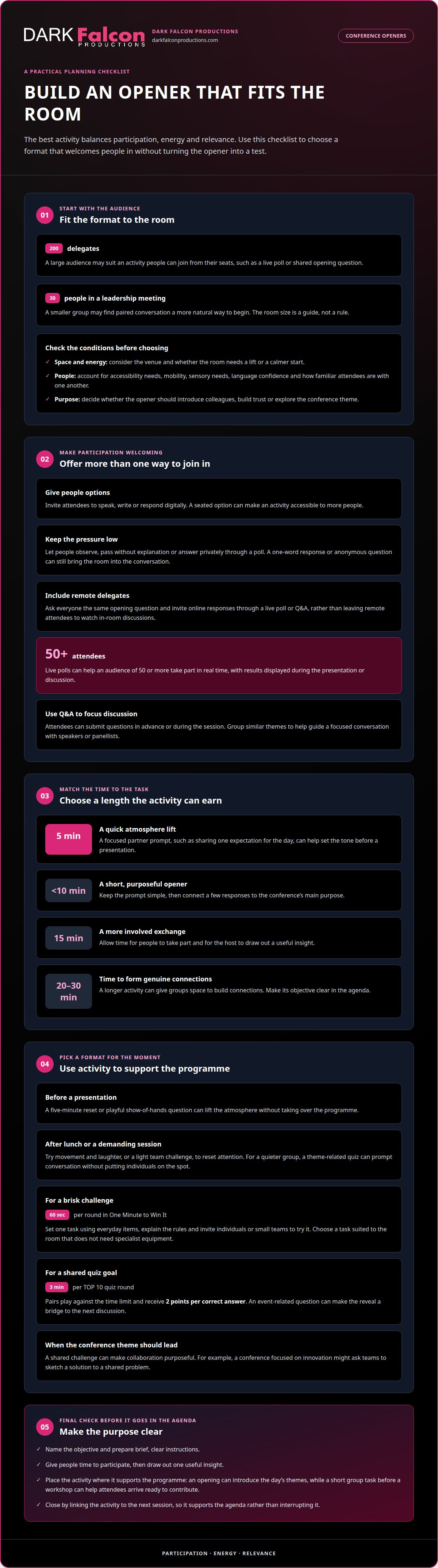
A strong opener fits the room, audience and purpose. A session for 200 delegates may call for a different format from a leadership meeting of 30. Consider the available space, energy level, accessibility needs, language confidence and whether attendees already know one another.
Choose the format before writing the instructions. For a large audience, use an activity people can join from their seats; for a smaller group, paired conversation may feel more natural. Make the invitation clear, offer a simple way to participate and avoid turning the exercise into a test.
A keynote can capture attention with a personal story or a link to a current news story that sparks interest, according to NHS. Connect that opening to the conference theme, then give the audience a prompt that invites reflection or conversation.
For a hybrid or virtual event, give remote delegates an active role rather than leaving them to watch in-room discussions. Ask everyone the same opening question and invite responses through a live poll or online Q&A. Live streaming can also bring in attendees joining from different places.
Live polls let organisers ask attendees questions during presentations or discussions and display results immediately. They can help an audience of 50 or more take part in real time, while giving speakers a clear picture of the room’s responses.
Q&A gives attendees a direct way to engage with speakers, panellists or workshop leaders. Let people submit questions in advance or during the session, then group similar themes to guide a focused discussion.
For an inclusive icebreaker, offer several ways to contribute, such as speaking, writing or responding digitally. Consider mobility, sensory needs and language confidence when choosing movement, noise and instructions. A seated option can make participation accessible to more attendees.
Keep it low-pressure for people who dislike icebreakers. Let attendees observe, answer privately through a poll or pass without explanation. A one-word response or anonymous question can still bring the audience into the opening conversation.
2. Purposeful team-building activities and icebreakers
First decide what the activity should achieve: introducing colleagues, building trust or exploring the conference theme. Then choose a format that supports that purpose. Speed networking encourages brief introductions, while a shared challenge gives attendees a reason to collaborate beyond their usual teams.
For a quick opener under 10 minutes, ask each person to share one expectation for the day with a partner. Five minutes can be enough to lift the atmosphere at the start of a presentation, provided the prompt is focused and simple. Keep instructions brief, then connect a few responses to the conference’s main purpose.
To plan and run a memorable opening, put the activity into the agenda, name its objective and prepare clear instructions. Allow time for people to take part and for the host to draw out one useful insight. A 15-minute opener may suit a more involved exchange, whilst an activity lasting 20 to 30 minutes gives groups time to form genuine connections.
Place the icebreaker where it supports the programme. An opening activity can introduce the day’s themes, while a short group task before a workshop can help attendees arrive ready to contribute. Avoid placing a lengthy exercise beside a keynote or leaving its purpose unclear in the agenda.
After lunch, choose movement and laughter over another discussion-led task. A light team challenge can reset attention without asking people to absorb more presentation content. For a quieter group, try a theme-related quiz that prompts conversation without putting individuals on the spot.
Reflect the organisation’s brand values in the activity’s subject and format. A conference focused on innovation might invite teams to sketch a solution to a shared problem. NHS describes a hands-on workshop where attendees built and programmed Lego robots, sparking creativity and teamwork.
Make the experience purposeful, not performative. Explain why the task matters, give each group clear roles and close by linking the activity to the next session. This helps the exercise support the agenda rather than interrupt it.
3. Conference energisers and team challenges
Five minutes can lift the atmosphere before a presentation or after a demanding session. Choose one simple action, explain it clearly and give attendees an immediate way to join. For example, invite the room to answer a playful question with a show of hands. A brief reset should shift attention without taking over the programme. Keep the prompt relevant to the conference so that energy carries into the next discussion.
For a more active format, One Minute to Win It uses a series of 60-second challenges with everyday items. Set one task, explain the rules and invite individuals or small teams to try it. The short rounds create a clear beginning and finish. Select a task that suits the room and doesn’t require specialist equipment. A host can keep the pace moving by announcing the countdown and recognising each completed challenge.
A quiz offers a focused alternative. In the ongoing TOP 10 quiz, pairs play each round against a three-minute time limit and receive two points per correct answer. That structure gives participants a shared goal and a reason to compare answers. Use a question connected to the event’s subject, then reveal the answer before the next session. A quick review can turn the game into a bridge towards the day’s discussion.
Organisers can gamify an event with quizzes, team challenges, leaderboards, prizes or a conference-wide scavenger hunt. Choose one mechanic that supports the session’s purpose instead of combining every option. A scavenger hunt, for instance, could ask teams to find information linked to the venue or conference theme. Keep the instructions visible, make progress easy to follow and explain how the activity ends. If you use a leaderboard, recognise participation and collaboration, not just winning. A clear finish helps attendees return their attention to the main programme.
4. Fifteen conference icebreaker ideas
For a smaller group, try paired introductions or storytelling in groups of five. For a larger audience, use a live poll, theme quiz or coffee-break assignment to encourage participation across the room.
- Paired introductions: Give partners five minutes to learn about one another, then share a common interest.
- Human bingo: Use a 5×5 card, with prompts such as visiting more than 15 countries.
- Work-history bingo: Add a square asking who has worked at one company for over 10 years.
- Coffee-break mission: Invite each attendee to meet three new people during the break.
- Two truths and a lie: Ask each person to share two true facts and one false statement.
- Energy check: Poll the audience to rate its energy from 1 to 10.
- Speed networking: Rotate short partner conversations around a prompt linked to the conference theme.
- Theme quiz: Ask questions related to the event topic, then compare answers in pairs.
- Storytelling prompt: At FRESH in Copenhagen, participants had 10 minutes to reflect and note key points.
- Small-group stories: FRESH participants formed groups of five for a storytelling icebreaker.
- Shared challenge: Give groups one problem connected to the event and invite a practical solution.
- Question exchange: Ask attendees to write a question they hope the conference will answer.
- Theme association: Invite each person to offer one word that captures the event’s central idea.
- Partner expectations: Ask pairs to discuss what they want to take away from the day.
- Photo prompt: Invite attendees to capture an image representing the conference theme and explain their choice.
Make the choice fit the room: paired conversation suits a smaller gathering, while polls and quizzes reach a wider audience. To shape a distinctive opening around your event, develop a creative conference concept.
Dark Falcon Productions: Creative
Dark Falcon Productions can help shape the creative direction of a conference opening when an event needs a clear, engaging idea. A considered concept can connect the icebreaker to the event’s purpose and give the opening a consistent tone.
For conferences that need content beyond the room, Shorts and social media management can help share event moments. Dark Falcon Productions’ Events offering can support an opening that forms part of a wider event experience. The right approach depends on the event’s objectives, audience and intended message, so each creative choice serves a purpose.
If you’re developing an opening for an upcoming conference, visit darkfalconproductions.com to discuss your creative direction.
Shape an opening with lasting impact
The opening can set the creative direction for the whole conference. Treat it as part of the event’s wider story: decide what you want attendees to feel, consider what they should carry into the programme and shape each moment around that intention. Whether framing sessions around leadership and personal development with a speaker such as David James Rhodes or launching collaborative exercises, the most effective creative ideas for conference openers do more than start a session; they give the event a distinctive identity that can continue beyond the room.
Dark Falcon Productions can help develop the creative direction and connect it with content for the event’s wider audience. Its Creatives work can inform the concept, while Shorts and social media management can help share conference moments. This lets organisers plan the opening as part of a broader communications approach.
Contact Dark Falcon Productions today to discuss a creative direction for your conference. Give your next opening a clear purpose and a confident start.
Frequently Asked Questions
What makes a conference icebreaker work?
A conference icebreaker works when its prompt is easy to understand and relevant to the event’s purpose. For example, ask delegates to name one change they hope their industry will make, then use the responses to frame the next discussion. Let people contribute in different ways, such as speaking or writing. A clear link to the programme makes the activity feel purposeful rather than like a diversion.
What are engaging icebreaker activities for a professional conference?
Try a shared case-study exercise: present a realistic workplace dilemma and invite small groups to choose their response. Each group can give one reason for its decision, creating a useful exchange without requiring personal disclosures. Another option is a collective word board where attendees add a phrase describing a challenge in their field. The host can draw out common themes and connect them to the conference sessions.
What conference openers work best for large groups of strangers?
For a large group of strangers, choose an activity that lets people participate without addressing the whole room. A prompt board works well: ask attendees to add one idea or challenge on arrival, then highlight recurring themes from the stage. Table-based scenario discussions also help people start talking in a smaller setting. Give each table a specific question and invite one voluntary observation to share with the wider audience.