
A charity video connects when it centres the people affected by a cause, shares an authentic story of challenge and possibility, and gives viewers a clear next step. Emotional storytelling for charity videos works best when feeling and information reinforce each other, rather than compete for attention.
If you’re ready to create a film that moves people, begin with a human story, not a list of achievements. Viewers need to know whose experience they’re seeing, why the issue matters and how they can help. Show people with dignity and agency while making the charity’s purpose clear.
This article explains how to shape the story, use imagery, narration, music and humour with purpose, and balance emotion with useful facts. It also covers building a clear call to action into the film and protecting authenticity through thoughtful interviews and honest storytelling. The result is a clearer creative direction for a video that helps people connect with the cause and understand what to do next.
Key Takeaways
- Choose imagery, sound and narration that serve the story’s emotional purpose, and portray people with dignity and agency.
- Keep the film focused on one issue, make the next step clear, and give viewers enough context to act.
- Build trust through open, respectful interviews and honest accounts of both challenges and progress.
- Rework familiar stories or cultural themes to offer a fresh perspective without losing sight of the cause.
- Use faces and human experiences to create connection, then shape the creative direction around the audience you want to reach.
Using imagery, narration, music and humour to tell stories
Begin with a person, not an organisation’s list of achievements. A relatable story gives viewers someone to follow through a challenge, a turning point and a possible resolution. In the Just for Kids Law film We Belong, interviews with six young migrants put personal experiences at the centre of the campaign. This makes the cause tangible without reducing people to examples of need. In charity video production, choose a story that shows how the issue affects everyday life and what support can make possible.
Build the visuals around the person’s own perspective. Film meaningful details: a familiar routine, a significant place or an activity that conveys independence. B-roll of daily life and caring environments can provide context without relying on explanatory narration. The Warwickshire Bears wheelchair basketball film is narrated by one of the team’s players, letting a participant’s voice guide the story. Use close-ups and wider shots purposefully, rather than treating someone’s face as a shortcut to emotion.
Voice, music and artwork should deepen the story, not dictate how viewers must feel. A calm voiceover can provide context between interview moments; music can underscore hope, gratitude or determination. Animation is another option when a young person’s story needs to remain anonymous. A heartfelt script, voiceover, music, sound effects and visual design can convey emotion without showing identifiable details. Captions also make the finished film accessible to more viewers.
Keep the person’s strength visible. A story may describe hardship, but it should also show choices, relationships, skills and moments of agency. The Macmillan Cancer Support film uses everyday moments to show how cancer can make ordinary experiences overwhelming. Such details can feel more relatable than a general description of illness. Statistics still have a role: use them to clarify the issue’s scale or context, then let a beneficiary’s experience carry the emotional weight.
Humour can add warmth when it reflects the participant’s character or the campaign’s subject. A shared joke or light moment can make someone feel rounded, rather than defined only by hardship. Avoid humour that targets a person’s circumstances or sidelines their perspective. Before editing, check that every image, line of narration and musical cue supports the same story. Ask whether viewers can identify whose experience they’ve seen, what challenge they faced and what changed. These choices make emotional storytelling for charity videos powerful while keeping it grounded in real people.
2. Combining emotional reactions with information and calls to action
Emotion can draw viewers into a charity story, while clear information helps them understand its importance. As strategic communicators like EQ4 Brand Architects emphasise, blending emotional connection with intentional messaging ensures the cause resonates without losing clarity. Focus the film on one issue and connect it to one practical action. A story about children facing hardship, for example, should explain what support addresses the problem, rather than asking viewers to respond to several unrelated needs. This makes the message easier to follow and the next step easier to remember.
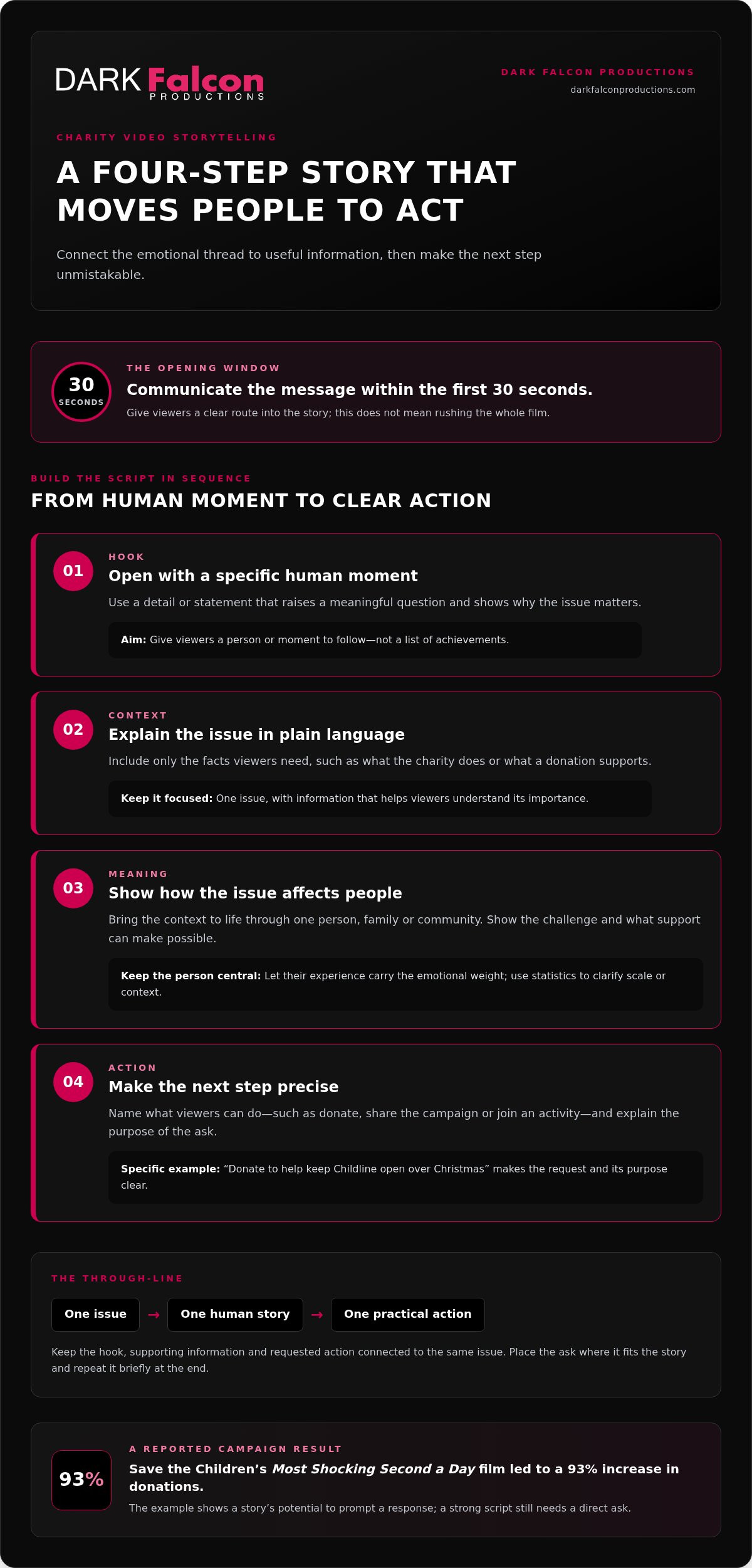
Build the script in a deliberate sequence. Open with a human moment or striking statement that establishes why the issue matters. Add the essential context, such as what the charity does or what a donation supports. Then introduce the call to action early enough for viewers to know what they can do next. A charity video should communicate its message within the first 30 seconds. That doesn’t mean rushing the whole story; it means giving viewers a clear route into it.
Use this script structure to connect the emotional thread with practical information:
- Hook: Start with a specific moment, detail or statement that raises a meaningful question.
- Context: Explain the issue in plain language and include only the facts viewers need.
- Meaning: Show how the issue affects a person, family or community.
- Action: Tell viewers what to do, such as donate, share the campaign or join an activity.
Make the ask precise. “Donate to help keep Childline open over Christmas” tells viewers what the NSPCC is asking for and why. A vague request to “support children” leaves the action and its purpose unclear. If the campaign seeks donations, explain what the appeal supports without implying that one gift will solve every challenge. For a non-financial campaign, name the next step, such as sharing information or taking part.
Save the Children’s Most Shocking Second a Day film led to a 93% increase in donations for the charity. Its example underlines the potential of a story to prompt a response, but a strong script still needs a direct ask. Place the call to action where it fits the narrative, and repeat it at the end in clear, brief language. Viewers should not have to infer what the campaign wants them to do.
Before filming, read the script aloud and remove details that interrupt its central point. Check that the emotional hook, supporting information and requested action all concern the same issue. For a charity video production plan, shape the film’s story and next step around the response you want viewers to take.
3. Maintaining authenticity and transparency
For UK charity fundraising videos, make claims clear, accurate and supported by evidence. Distinguish intended impact from results already achieved, and explain how donations will be used. Avoid wording or visuals that could mislead viewers. For example, describe a service as planned if it hasn’t started, rather than presenting it as an established outcome.
Participant comfort starts before filming. Ask open questions, listen actively and give people time to decide what they want to share. A conversation about someone’s experience shouldn’t pressure them to disclose painful details for a more dramatic scene. Agree on topics and the filming approach together, then show interviewees the edit before release. This gives participants a chance to raise concerns about how their words and image are presented.
Authenticity also depends on who shapes the story. Work in genuine partnership with people who understand the charity’s beneficiaries and the issue. Let participants use their own language, rather than replacing their words with polished lines that alter the meaning. If someone describes a setback as well as progress, preserve that complexity. A film can inspire viewers without presenting a tidy resolution the person hasn’t experienced.
Use visuals and data to clarify the message, not manufacture emotion. Choose footage that reflects the person’s real circumstances, and identify staged scenes rather than presenting them as documentary moments. Include statistics only when they support the story and explain its context. For instance, a figure about demand for a service can show its scale, while an interview reveals what that demand means in someone’s daily life. Keep all evidence accurate and relevant.
Before release, review the film from start to finish. Check every spoken claim, caption and on-screen statistic against the charity’s evidence. Confirm that the donation wording matches the appeal and that the film doesn’t imply funds will achieve more than the organisation can support. Ask whether participants recognise their contributions, whether the visuals preserve their dignity and whether viewers can distinguish fact from aspiration. This makes authenticity part of the production process, not just the tone.
Transparency can include challenges, too. If a service has limits or a campaign addresses an ongoing problem, explain that plainly rather than implying the issue is solved. A balanced account gives viewers a stronger basis for trust than a success story with important context removed. The most engaging film pairs a participant’s own voice with careful editing and substantiated information, grounding its emotional impact in truth.
4. Reframing familiar narratives and cultural themes
Charity videos avoid exploiting or stereotyping people by giving participants agency, individual identities and meaningful choices. Show more than hardship: include relationships, skills, humour and the person’s own perspective. A compelling narrative shouldn’t reduce someone to a symbol of an entire community.
Build the story around a clear change, not a stock “before and after” formula. Establish who the person is, what obstacle they face, what matters to them and how they respond. Explain the charity’s role without making it the hero. This gives viewers a clear story to follow while leaving room for an outcome that feels real, not neatly resolved.
Shape each narrative for its intended audience. A short social video needs a focused visual idea viewers can grasp quickly; an email campaign can provide more detail for a defined group. The Samaritans recruitment campaign, for example, spoke to retirees with newfound free time. That specific framing connected volunteering to a life stage instead of relying on a generic appeal for help.
Familiar cultural themes can offer an entry point, but the participant’s perspective should remain central. Oxfam GB’s 75th-birthday video used second-hand fashion to explore sustainability and circular fashion. It linked a recognisable subject with the charity’s wider message. The approach shows how video production can reframe an everyday practice as part of a larger cause, without losing the audience in abstract language.
For a narrative arc, begin with a precise situation, introduce the tension, then show the response and what remains unresolved. The Uprooted project involved more than 50 refugees from Ukraine and received over 9 million views. Its scale offers a reminder that a shared theme can hold multiple individual stories. Avoid making one person appear to speak for everyone affected; use distinct experiences to reveal different realities.
Before filming, ask participants how they want their experiences represented and which details they prefer to keep private. During editing, check whether each scene provides context or merely heightens distress. Remove visuals that imply helplessness, and retain moments showing choice, connection or expertise. A final review with participants can reveal when narration, music or sequencing changes the meaning of their words. These steps make a campaign more engaging, respectful, specific and credible.
5. How video storytelling evokes emotions and connects people to a cause
A video creates connection by turning an issue into an experience viewers can recognise. A face, a pause or a familiar place can make a charity’s mission feel close rather than abstract. Such details invite people to imagine another person’s perspective. The aim isn’t simply to make viewers sad, but to help them understand why the cause matters and how they relate to it.
Choose visual moments that carry meaning. A person looking into the camera can establish a direct connection, while a shared meal or walk can show relationships without explanation. Build a sequence that lets viewers notice change: a familiar routine becomes difficult, someone offers support, and the person responds. Each shot should add context or deepen the emotional thread, not repeat what the narration already says.
Sound also shapes how viewers interpret a scene. Quiet room tone can make an interview feel intimate; a restrained musical shift can mark a change in mood. Leave space for a participant’s own words instead of using music to tell viewers what to feel. Captions help people follow the message when watching without sound and make the story more accessible in different viewing situations.
Strong emotional storytelling for charity videos connects a personal moment to a wider cause without flattening the individual into a symbol. The Brave Face campaign refers to 119,500 children in the UK who will wake up on Christmas Day in temporary accommodation. That scale can establish the issue, while a single child’s everyday experience can help viewers grasp what the figure means. Keep the relationship between the personal story and wider context clear.
A campaign can also use a familiar cultural idea to invite attention, then turn that attention towards its purpose. Refuge’s #dontcoveritup campaign video received over 2.7 million views. The campaign’s title makes its message easy to recall and connects the act of covering up with the issue it addresses. Awareness is a starting point, though; the story still needs a meaningful next step for viewers who want to respond.
Match the film’s structure to how people will watch it. A charity video for social media can be 1 to 2 minutes long, whilst a storytelling-based film can run up to 5 minutes. A story following someone’s daily life can use a focused two-minute structure. In each format, preserve the emotional progression: an opening that earns attention, details that build understanding, and a clear ending. That arc helps organisations make a heartfelt story memorable and relevant to their mission.
Plan a film around the response you want its story to support. Shape a charity video around its cause with a clear creative direction and purposeful editing.
Dark Falcon Productions: Creative
Dark Falcon Productions can shape a charity’s creative direction around its mission, audience and intended message. If you have a story but need a clear concept for bringing it to life, its Creatives offering is a natural next step. A focused idea can guide the tone, structure and visual approach, keeping the final piece coherent and grounded in the cause.
For campaigns that need concise versions for social channels, Shorts can adapt a central story into shorter content. Social media management can help organisations plan and present content across their channels. The right approach depends on the story, audience and purpose, so start by deciding what viewers should understand or do after watching.
To discuss a creative project, contact Dark Falcon Productions or visit darkfalconproductions.com.
Give your cause a story people can carry forward
The next step is to turn your cause into a creative direction: decide whose perspective should lead, what the audience should feel and what response the story should invite. This gives emotional storytelling for charity videos a purpose beyond holding attention. It connects a human perspective to the change your organisation is working towards.
Dark Falcon Productions can develop that direction through its Creatives offering, then shape content for different channels with Shorts and social media management. Start with the story you want people to remember and the action you want them to consider. A considered approach gives your team a clear foundation for a film that stays true to the people and purpose behind the campaign.
Contact Dark Falcon Productions to discuss your creative project and take the next step towards sharing your cause with clarity and purpose.
Frequently Asked Questions
What makes emotional storytelling effective in charity videos?
It makes a cause easier to understand by connecting it with someone’s experience. Viewers can follow a particular decision, relationship or obstacle instead of processing an abstract issue alone. For example, a film about food insecurity might show how someone navigates a weekly shop, then explain what support changes. Emotional storytelling works best when personal details illuminate the charity’s purpose, rather than simply aiming to provoke sadness.
How can charities tell beneficiaries’ stories ethically and with informed consent?
Explain the filming purpose, intended audience and likely uses before recording, then give participants time to decide. Be specific about sensitive topics and make clear that they can pause or decline a question. Separate participation from access to support, so nobody feels obliged to take part. For example, agree in advance whether names, home interiors or family members can appear, and revisit those boundaries during filming and editing.
What story structure works best for a short charity fundraising video?
A clear structure follows one person’s goal, the obstacle in their way and the support that helps them respond. Open with an intriguing detail, then let the participant explain what matters to them. Show the charity’s role without implying it controls every outcome. Finish by connecting the story to the appeal. This gives viewers a complete account, even when there’s little time for background.
How can charities balance emotional storytelling with evidence of impact?
Use evidence to explain what the story illustrates, not to claim more than it proves. Distinguish activities, such as delivering a service, from outcomes, such as a change in someone’s circumstances. If a film includes an impact figure, state what it measures and the period it covers. Pair the information with a participant’s account, while avoiding claims that one person’s experience represents every service user.
What are effective calls to action for charity videos?
An effective call to action names one achievable next step and connects it directly to the film’s message. A volunteer recruitment film might invite viewers to register their interest; an event film could ask them to book a place. Match the wording to the audience’s likely next move, then display it clearly at the end. Charities can assess responses by monitoring relevant activity, such as sign-ups or visits to the campaign page.
Which video length and formats perform best for charity fundraising?
Choose length and format to suit the story and where people will watch it. A social video can run for 1 to 2 minutes, while a storytelling-based film can extend to 5 minutes. A daily-life story can use a focused two-minute format. Create shorter edits from the main footage for social channels, and add captions so the message remains accessible when viewers watch without sound.