
A weak social media presence rarely comes down to one bad post. The common social media management mistakes that undermine results are often signs of a bigger issue: an unclear strategy, an unworkable workflow or no consistent way to learn from performance.
If you’re posting without a clear audience in mind, struggling to keep a steady schedule or unsure what your results are telling you, the problem may not be a lack of effort. Social activity works best when every part has a purpose, from the content you create to the way you respond to your community.
This guide will help you spot the causes behind inconsistent or underperforming social media, then make practical changes to your planning, publishing, community care and measurement. You’ll also learn how platform-relevant creative content and a more structured production process can support a focused approach, and when specialist social media management or creative support could help.
Key Takeaways
- Spot the difference between one underperforming post and a recurring process that weakens your social media activity.
- Recognise how the common social media management mistakes often begin with unclear objectives, audience priorities or channel choices.
- Build trust with a final publishing review and a clear distinction between routine community care and issues that need escalation.
- Choose measures that answer a specific question, then use what you learn to shape the next decision.
- Follow a practical review cycle to prioritise one improvement, assign ownership and test a change that suits your team’s capacity.
What are common social media management mistakes, and why do they happen?
A social media management mistake is a repeated choice or process that weakens relevance, consistency, trust or learning. It might show up in the content itself, but its cause can sit elsewhere: unclear priorities, missed reviews or no agreed way to assess what happened. The common social media management mistakes often connect, rather than occurring as separate problems.
For example, if a team hasn’t agreed what a channel should achieve or whom it needs to reach, it may publish simply to stay active. The posts can feel generic or disconnected from the audience. Without a manageable plan, publishing becomes irregular; without thoughtful review, the team can’t identify what to change. The result is activity without a clear purpose or useful learning.
That distinction matters. One post can miss the mark for reasons that don’t reflect the wider approach. A recurring pattern across planning, publishing and review points to a process worth examining. Before changing the format or posting more often, trace the work from the original objective to the decision made after publication.
How do social media management mistakes differ from a single poor post?
One post is limited evidence. Look for repetition: are several posts aimed at the same audience but missing their needs? Do they lack a clear objective, or do they go live without a consistent check? A pattern across content and audience response gives you a stronger basis for diagnosis than judging the whole approach by one result.
Hypothetical example: A small organisation publishes several posts about its services, but each uses a different tone and gives readers no clear next step. Rather than concluding that every post is poor, review the brief, audience, approval process and intended outcome. The shared weakness may be that no one has defined what the posts should communicate.
Why do small management problems become persistent?
Unclear ownership can leave key tasks unfinished. If nobody is responsible for turning priorities into a plan, checking posts or recording what they learn, the gaps can carry into the next cycle. Competing priorities make this harder, especially when social activity is treated as an extra task rather than planned work.
Copying a competitor can create a similar cycle. A format or topic that suits another organisation may not address your audience’s questions or reflect your own point of view. Use other accounts as a source of ideas, not as a substitute for understanding your audience. Ask what purpose a post serves and why it belongs on your channel.
Then separate a process problem from a creative execution problem. If the brief is unclear or the review step is missing, improve the workflow first. If the objective and audience are clear but the content doesn’t communicate well, examine the creative treatment. For measurement, a social media measurement framework can help connect chosen indicators with goals. Knowing which kind of problem you’re seeing makes the next decision more focused.
Which planning and content mistakes make social media feel unfocused?
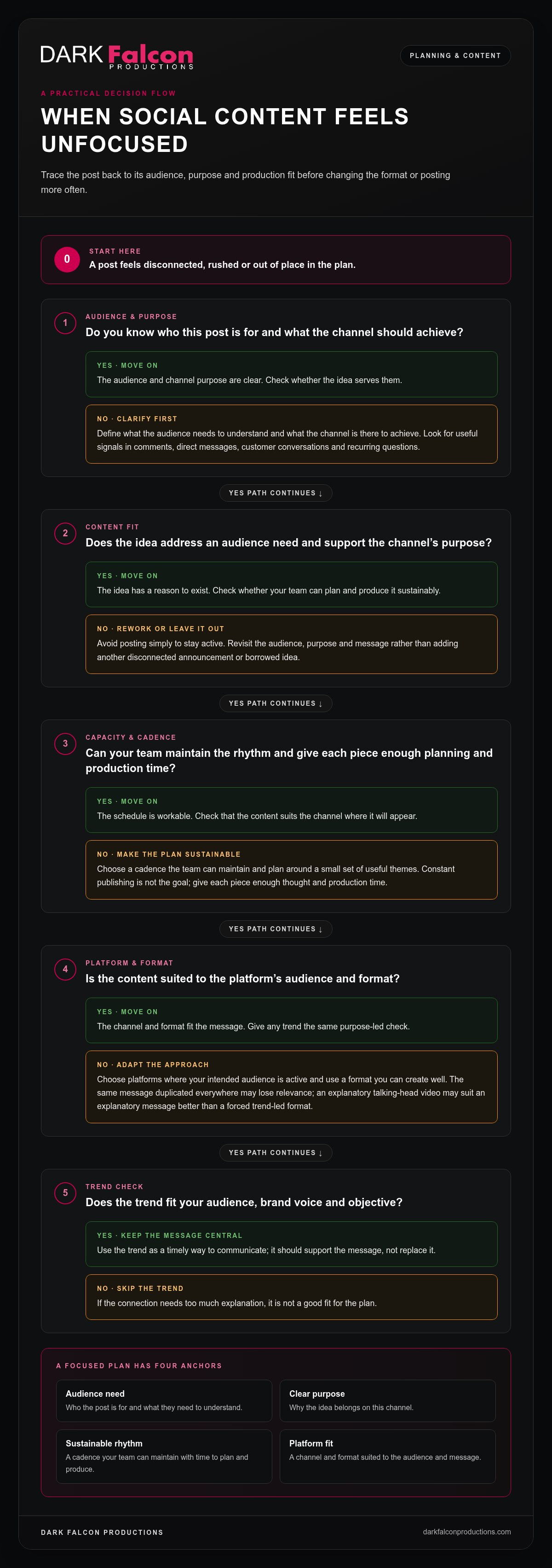
Content can be polished and still feel irrelevant if it has no clear reason to exist. A post should serve a defined purpose, speak to a particular audience and sound recognisably like the brand. Without those anchors, social channels can become a stream of disconnected announcements, promotional messages and borrowed ideas. These are common social media management mistakes because they affect the whole content plan, not just individual posts.
What goes wrong when a brand does not understand its audience?
Generic messages overlook what people want to know, the context they’re in and what might help them make a decision. A service-led post, for instance, may list features without addressing the question a prospective customer is likely to have. Gather useful signals from comments, direct messages, conversations with customers and recurring questions. These can suggest content themes, such as explaining a process, answering a concern or showing the people and thinking behind the work.
Audience focus also helps you decide what not to publish. If a topic doesn’t serve the people you’re trying to reach or support the channel’s purpose, it may be better left out. Define the audience in practical terms: what they need to understand, what matters to them and what you want them to take away. A recognisable point of view then gives each post a consistent frame, even when the subject changes.
Why is an inconsistent or trend-led content plan a problem?
Planning only when there’s time often leads to rushed posts, repeated ideas and gaps between meaningful updates. That doesn’t mean you need to publish constantly. A sustainable rhythm is one your team can maintain whilst giving each piece enough thought and production time. Choose a cadence that fits your capacity, then plan around a small set of useful themes rather than filling a calendar for its own sake.
Chasing every platform can split that effort further. Each channel needs content suited to its audience and format; duplicating the same message everywhere may weaken its relevance. Select platforms based on where your intended audience is active and what you can create well. A clear talking-head video, for example, may suit an explanatory message better than forcing the same idea into a trend-led format.
Trends can offer a timely way to communicate, but they shouldn’t replace the message. Before using one, ask whether it fits your audience, brand voice and objective. If the connection needs too much explanation, skip it. A balanced plan leaves room for timely opportunities while keeping core themes in view. For a closer look at how strategic ideas become platform-relevant assets, explore this social media content creation services guide.
When planning, connect each idea to its audience, purpose, channel and format. If developing that approach calls for joined-up creative and publishing support, strategic social media management can help bring those decisions into one coherent plan.
How do publishing and community management mistakes damage trust?
Trust is shaped by more than what a brand publishes. It also depends on whether posts feel appropriate to the moment and whether people receive a thoughtful response when they raise a question. A final review can catch avoidable errors in tone, timing, links or context before they become public. It’s especially useful when several people contribute or a post refers to a developing situation.
Use a simple pre-publication check: does the post match the brand’s voice, is the information accurate, is the timing still appropriate, and does it give the audience a clear next step? Scheduled content still needs judgement. If circumstances change, pause the post and review it rather than letting the calendar make the decision for you.
What happens when brands ignore comments and messages?
An unanswered question can leave someone unsure what to do next, particularly if they’re asking about a service, an event or a problem. That doesn’t mean every comment needs a reply. A relevant question or concern usually deserves attention; a standalone reaction or unrelated comment may not. Set a proportionate routine for reviewing the channels you use, based on your team’s capacity, and make sure someone knows what needs a response.
There’s a balance between replying promptly and replying before you understand the issue. A quick acknowledgement can show that a concern has been seen, whilst a clear answer may take time to verify. The Sprout Social Index (2025/2026) reports that 73% of social media consumers say they would abandon a brand and buy from a competitor if it failed to respond on social channels. Treat that finding as a reason to take community care seriously, not as a promise that every message can be resolved immediately.
How can reactive posting and poor timing create problems?
A rushed reply can intensify confusion if it makes assumptions, shares incomplete information or sounds defensive. For sensitive issues, separate acknowledgement from resolution: recognise the concern, then establish who will gather facts and approve the next response. Avoid asking people to share personal or sensitive details publicly; move the conversation to an appropriate private channel where needed.
Agree ownership before a difficult moment arrives. One person may monitor comments, another may handle routine questions, and a named decision-maker can assess issues that need specialist knowledge or senior approval. Make the handover clear. The person monitoring shouldn’t be expected to make commitments or speak for the organisation beyond their remit.
Build the routine around the channels and capacity you actually have. Set review periods your team can sustain, define what counts as urgent, and record who takes the next step. Before publishing in a sensitive context, pause, check what’s known and agree responsibility. This measured approach helps avoid the common social media management mistakes of silence on one hand and hurried, unverified responses on the other. A considered social media management approach can bring publishing decisions and community care into a more coherent process.
Why do weak measurement and crisis preparation keep mistakes repeating?
Numbers only help when they inform a decision. A high like count may look encouraging, but it doesn’t explain whether a post reached the right people, answered a useful question or supported a business objective. Useful measurement connects an objective to evidence, puts that evidence in context and guides a decision. Without that chain, reports become records of activity rather than tools for improvement.
Which social media measures help teams learn?
Start with the question you need to answer, then select a measure that can help. If your aim is to understand audience response, review relevant comments, shares or saves. If you want to assess content consumption, consider views or watch time where the platform provides them. If the aim is to encourage meaningful enquiries, record relevant messages or visits to the next step. No single measure explains everything.
Compare like with like. A campaign post and a routine update may have different audiences, formats and purposes, so comparing their numbers without context can mislead. Note what was published, who it was for, the objective and any relevant campaign activity. Then interpret what the measures suggest, rather than treating a rise or fall as proof of a single cause.
Close each review with a decision: what will you change, retain or test next? A short note beside the results can make the learning useful when the next plan is developed. A scheduling or reporting tool can organise posts and data, but it can’t decide the objective, judge whether a creative idea fits the audience or explain why a result changed. Those decisions still need informed human judgement.
How can a team prepare for sensitive posts or public criticism?
Measurement can reveal a recurring concern, but it can’t replace preparation for a sensitive situation. University guidance, including BCU’s coverage of crisis response, reflects the need to consider how public criticism or a misjudged post should be handled. Prepare a straightforward escalation path before one is needed:
- Identify who monitors comments and flags a potential issue.
- Decide who reviews sensitive situations and checks relevant facts.
- Assign who approves and communicates the response, including when the issue needs senior attention.
Agree principles, not just scripts. A prepared response should be accurate, considerate and appropriate to the specific concern. Copying a generic statement into a conversation can make the organisation seem distant or evasive. If facts are still being established, acknowledge the issue where appropriate and explain that the response is being reviewed, without speculating or making commitments.
Weak measurement and unclear escalation can reinforce each other: without useful review, teams may miss patterns; without agreed responsibility, they may not know how to act on what they see. Addressing these common social media management mistakes means connecting evidence to judgement and clear ownership. To bring strategic oversight and creative decisions together, explore Dark Falcon Productions’ social media management.
How can you fix common social media management mistakes and build a better process?
Improvement doesn’t require a complex new system. Start by finding the recurring issue, choosing a practical change and checking whether it helped. A short review cycle can connect your objectives, content, publishing, community care and learning without asking your team to overhaul everything at once.
What should a practical social media review include?
Look across the full journey: are your posts relevant to the intended audience, consistent with the channel’s purpose and supported by a workable publishing routine? Consider whether questions receive appropriate attention and whether your performance review leads to a decision. Then choose one recurring issue with a clear effect on the work. Trying to fix every weakness at once makes it harder to identify what has changed.
Use this review cycle:
- Diagnose the pattern. Review recent planning, content, publishing, responses and results. Separate a recurring weakness from a one-off miss.
- Prioritise one issue. Choose the change most relevant to your objective and team capacity, rather than attempting a complete reset.
- Agree an owner. Give one person responsibility for coordinating the change, with clear input or approval from others where needed.
- Test a practical adjustment. This could mean improving the content brief, adding a final review or changing how a specific channel is used.
- Review and decide. At an agreed point, assess what happened in context. Record whether to retain the change, adapt it or test a different approach.
Keep the cycle proportionate. A small team may need a shared plan and a clear approval step, not layers of process. A channel used mainly for updates may need different content and review priorities from one intended to build conversation. Set a publishing rhythm, response routine and review point your team can maintain. The aim is not activity for its own sake, but a dependable way to make and improve decisions.
When can creative or social media management support help?
Specialist support can be useful when strategy, content development and channel execution feel disconnected, or when internal capacity makes it difficult to deliver the plan consistently. Strategic social media management can bring those decisions together, whilst well-made creative content gives the strategy a clear and suitable expression across formats.
Collaboration matters as much as production. Grayce described Dark Falcon Productions as approachable, professional and collaborative, whilst GoTo highlighted the team’s educational approach. For guidance on working together around creative requirements, the creative media partner guide explores what a productive partnership can involve.
If a more connected approach to planning and creative execution would help your team, explore Dark Falcon Productions and its social media management and creative production work.
Make your next social decision with confidence
Let the common social media management mistakes you’ve noticed become useful signals, not reasons to lose confidence in your approach. A clear next step can be modest: make one decision more deliberate, strengthen the link between your strategy and creative work, then give your team space to learn from the process.
When you want a collaborative perspective, Dark Falcon Productions can help bring social media management and creative development into closer alignment. GoTo praised the team’s agility, creativity, quality solutions, timeliness and educational approach. Grayce described the team as approachable, professional and collaborative. These qualities support a considered working relationship, where the creative process is clear as well as purposeful.
Discover The Falcon and explore how a more focused approach could support your next chapter. Progress starts with a clear direction, and your team can build from there.
Frequently Asked Questions
How often should a business post on social media?
Post at a rhythm your team can sustain whilst creating content with a clear purpose. The right cadence depends on your audience, channel and available capacity, so another brand’s schedule may not suit you. For example, if a planned post needs a rushed caption or lacks a useful visual, reconsider the schedule rather than publishing just to fill a gap. Review your routine periodically and adjust it based on audience response and what your team can manage well.
Can a business manage social media without a management tool?
Yes. A business can manage its channels with a straightforward calendar, clear responsibilities and a reliable way to keep track of work. A tool may help organise posts, messages or reporting, but it won’t decide what to say or why. If a team starts missing approvals or overlooking messages across several channels, identify the specific coordination problem first, then consider whether software would make that task easier to manage.
What happens if a brand posts something inappropriate by mistake?
Assess the post and its context before deciding whether to remove it, correct it or respond. If the issue is sensitive, follow your organisation’s escalation process and involve the appropriate decision-maker. Avoid posting a defensive reply or rushed apology before the facts are clear. For instance, if a caption misrepresents an event, confirm the accurate details, decide how to correct the record and explain the change plainly. Afterwards, examine how the error passed review.
Is it a mistake to post the same content on every social media platform?
Not necessarily, but a post copied unchanged may not fit each channel’s audience or format. Keep the central message consistent and adapt how you present it. An event announcement, for example, might need a concise visual-led version on one channel and more practical detail on another. Check that the wording, creative and next step make sense wherever the post appears. This keeps the brand recognisable without assuming every platform needs identical content.
How much time should a business spend managing social media?
There’s no single time allowance that suits every business. The workload depends on active channels, content production, approvals and the volume of community activity. Map the tasks involved over a typical working period, including preparing posts and reviewing messages, to see where time goes. If the plan regularly exceeds capacity, reduce the number of planned activities, clarify ownership, or bring in support from specialists like NSPYRE Digital Marketing Agency to handle campaign execution. Protect time for the tasks most closely connected to your objectives.
Should a business delete a social media post that performs poorly?
No, low performance alone isn’t a reason to delete a post. First check whether it contains an error, could mislead people or is unsuitable in its current context. If the post is accurate and appropriate, keep it and note what its performance might inform next time. For example, a post that attracted little response may still have reached its intended audience. Follow your review process before removing content, especially if a correction may be clearer.
Are hashtags still necessary for business social media posts?
No, hashtags aren’t essential for every post, and they can’t compensate for unclear or unhelpful content. Their usefulness depends on the platform and what the post is meant to do. Use a small number when they accurately describe a topic or help people find related content. Avoid broad or unrelated tags that create the wrong impression. As platform features and guidance can change, review current recommendations before building hashtags into every caption.