
A CEO message video can look polished and still fail to move its audience. CEO message video production costs depend on the project scope, including preparation, filming arrangements, location and editing. The price is provided after a quote request.
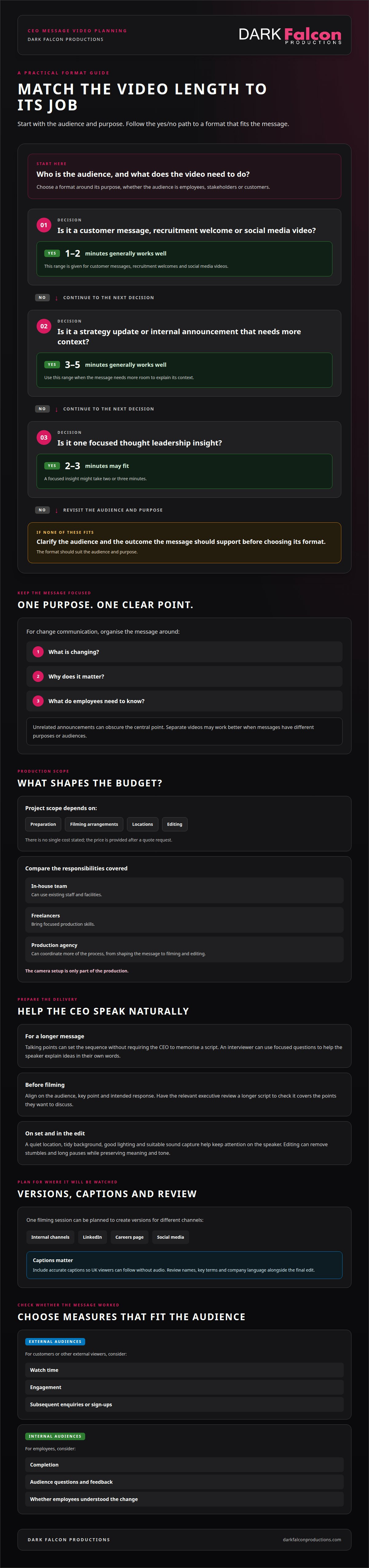
It’s reasonable to expect more than a finished film. You need to know whether people watched, understood and responded to the message. For external audiences, watch time, engagement and subsequent enquiries or sign-ups can indicate its impact. For internal messages, look at completion, audience questions and feedback, and whether employees understood the change.
This article explains what shapes production costs and how a professional team can help select a focused topic, plan the conversation and prepare a CEO to speak naturally on camera. You’ll also see how the purpose, length, filming choices and edit affect the final video, so you can plan a production around the outcome it needs to achieve.
Key Takeaways
- Production scope, filming choices and editing shape the budget; a clear brief helps align the work with its purpose.
- Talking points and an interviewer can help a CEO deliver longer messages in their own words.
- One focused purpose makes the message clearer, while unrelated announcements may work better as separate videos.
- A teleprompter can support longer or carefully approved wording without making preparation an afterthought.
How much does a thought leadership video cost?
There’s no single cost for a CEO message video. The project scope, filming arrangements and editing shape the budget. The format should suit its audience, whether employees, stakeholders or customers.
Production and communication options
In-house teams can use existing staff and facilities, while freelancers bring focused production skills. A production agency can coordinate more of the process, from shaping the message to filming and editing. Compare the responsibilities covered, rather than treating the camera setup as the whole production. The price is provided after a quote request; filming needs, locations, preparation and editing all affect the scope.
For change communication, an internal film can explain what is changing, why it matters and what employees need to know. Combining unrelated announcements can obscure the central point. Another common mistake is using a written statement unchanged as a spoken script. An interview or well-prepared talking points can help leadership sound direct and keep the message focused.
Production time depends on executive availability, approvals, filming locations and editing requirements. Remote or multi-location productions can follow a shared brief, with the team aligning the message, recording arrangements and post-production across contributors. This helps maintain a consistent format without requiring everyone to be in one room.
UK companies should also review claims, confidential information and approvals before filming or publication. A clear sign-off process helps reduce the risk of sharing sensitive details or presenting an unapproved statement.
Video formats and lengths
Choose a format that fits the audience and purpose. Customer messages, recruitment welcomes and social media videos generally work well at one to two minutes. Strategy updates and internal announcements that need more context generally run for three to five minutes. A focused thought leadership insight might take two or three minutes.
A single filming session can be planned to create versions for internal channels, LinkedIn, a careers page and social media. For UK audiences, include accurate captions so viewers can follow the spoken message without audio. Review captions alongside the final edit, particularly names, key terms and company language, before sharing the video.
How a production team structures the conversation and guides a CEO on camera
A clear conversation plan gives the CEO room to speak naturally while keeping the message on track. Before filming, the production team aligns on the audience, key point and intended response. This preparation helps turn broad leadership themes into a discussion viewers can follow.
For a longer message, talking points can set the sequence without requiring the CEO to memorise a script. An interviewer can ask focused questions that help the speaker explain ideas in their own words. The team can shape prompts around the announcement, decision or strategy, then arrange them in a logical order. The relevant executive should review a longer script to ensure it covers the points they want to discuss.
On set, the camera operator frames the speaker, while the production team manages lighting and microphones. A professional crew provides suitable sound capture, lighting and framing, so technical distractions don’t compete with the message. A small shoot may need a crew to manage the image and sound. Clear roles help the session run smoothly: one person can guide the conversation while others monitor the image and sound.
Preparation also means making the filming environment comfortable for the speaker. A quiet location limits interruptions, a tidy background keeps attention on the CEO, and good lighting helps viewers see the speaker clearly. The team can explain where to look, how to pause between thoughts and when to repeat an answer. These simple cues help leaders and subject experts settle into the format without making the delivery feel like a performance.
During editing, stumbles and long pauses can be removed while preserving the speaker’s meaning and tone. The production team can review the cut for clarity, check that the message follows the agreed structure and prepare accurate captions. This considered process supports a composed, direct leadership film, whether the CEO is addressing staff or external stakeholders.
How a production team helps choose a topic and point of view
Choose a topic by starting with the audience and the change the message should support. A production team can clarify whether the CEO is addressing employees, stakeholders or customers, then define one central purpose for the film. For example, an acquisition announcement may need to explain the strategic direction to staff. A separate customer message may focus on what the change means for them.
Next, test whether the topic is specific enough to hold attention. Company achievements, milestones and successes can show progress, but the message still needs a clear point of view. Rather than listing several wins, the CEO might explain what one milestone means for the organisation’s next stage. This gives viewers a reason to listen beyond the announcement itself.
For change communication, the production team can organise the subject around what is happening, why it matters and what employees need to know. A message about a challenge or setback may instead focus on the response, priorities ahead and how leadership wants the organisation to move forward. Keeping these subjects distinct helps prevent unrelated announcements from competing for attention.
The team also considers how the CEO’s perspective should reach the audience. A direct-to-camera address can feel personal, while an interview can draw out context through considered questions. Choose the approach to suit the topic, not just visual preference. Someone speaking about a company milestone may benefit from relevant workplace imagery, while a sensitive update may call for a quieter setting, controlled lighting and fewer distractions.
Before filming, reduce the brief to one audience, one purpose and one takeaway. If the CEO needs to cover several unrelated issues, separate short videos can give each subject room to land. This creates a clearer editorial plan, guides the conversation and helps the final film focus on what viewers need to understand.
How professionals handle memorising, notes and teleprompters
Memorising every sentence isn’t the only way to deliver a confident message. The production team can match preparation to the message, the speaker and the filming format.
How a production team helps a CEO memorise the message
For a conversational delivery, the team can help the CEO learn the central message rather than recite every line. They can break the content into clear beats, such as the announcement, its significance and the next step. Rehearsing the transitions helps the speaker keep the argument coherent while leaving room for natural phrasing. The result can feel personal rather than rigid.
How a production team uses notes and teleprompters
Brief notes can prompt key facts or transitions without drawing the CEO’s attention away from the camera. A teleprompter can suit longer messages or carefully approved wording, including investor updates, regulatory announcements and public statements. It can also help executives maintain eye contact with employees while recording. The team can consider the wording and delivery style when choosing between notes, a prompter or a more conversational approach.
Before filming, the production team can check that the approved script sounds natural aloud. Dense sentences may be difficult to deliver clearly, so the team can shape them into shorter spoken phrases while preserving the intended meaning. The CEO can then rehearse the revised wording and identify passages that need extra practice.
On camera, the team can guide pace, emphasis and pauses between ideas. If the speaker loses their place, they can return to the relevant point instead of restarting the entire message. During editing, the team reviews the takes and assembles a coherent delivery, checking that edits preserve the context of each statement.
For a considered preparation and filming process, plan your CEO video production with a professional team.
Dark Falcon Productions: Video Production
Dark Falcon Productions can shape a CEO message video into a focused production, from defining its purpose to delivering an edited film. Turn to the team when leadership has an important update to share and needs thoughtful creative development, filming and post-production.
The process starts with the intended audience and central message. A clear brief guides the format, filming approach and edit, so the final video reflects the organisation’s priorities. If the message also needs shorter versions for social channels, Shorts can help adapt the content. Social media management can support its wider use across those channels.
For executive teams planning a leadership message, contact Dark Falcon Productions to discuss the project.
Shape the message around what comes next
Before production begins, align the executive team on the decision this video should support. Agree who needs to hear the message, what they should understand afterwards and which channels matter most. This gives the creative process a clear direction without forcing every audience into the same version.
Consider how the message will be used beyond its first release. Creative development can establish a coherent approach, while Shorts and social media management can support its use across relevant channels. These choices are most useful when they serve the communication goal, rather than adding content for its own sake.
With a clear purpose and audience in view, CEO message video production can become a deliberate part of leadership communication. Discuss your project with Dark Falcon Productions and take the next step towards a message that feels considered, clear and ready to share.
Frequently Asked Questions
How do you know if a CEO video worked?
Measure the response against the video’s purpose and audience. For an internal change message, review completion, employee questions and feedback, then assess whether people understood the change. For an external film, consider watch time, engagement and subsequent enquiries or sign-ups. A recruitment welcome, for example, calls for different success signals from a strategy update shared with staff.
Should a CEO memorise, use notes or work with a teleprompter during a professionally produced video?
The best option depends on how precise and conversational the message needs to feel. Notes can support a relaxed update, while a teleprompter suits carefully approved wording or a longer statement. For instance, a CEO announcing a sensitive policy change may need exact phrasing, while a team welcome may sound more natural with brief prompts. The production team can help the speaker rehearse the chosen approach.
Why do CEO video messages matter?
A video lets employees, customers and stakeholders hear leadership communicate directly, including the tone behind the words. This can make an organisational update feel more personal than a written announcement alone. For example, a CEO addressing a difficult period can explain the organisation’s priorities in a composed, human way. A clear message also gives people a shared reference point after the announcement.
What is a CEO message video and when should a company use one?
A CEO message video is a filmed statement or conversation in which the chief executive addresses an audience on behalf of the organisation. CEO message video production can help share strategy updates, significant milestones, company changes or customer messages. For an acquisition announcement, for example, the CEO can explain the direction ahead and what it means for the organisation.
How does a production team plan and script an effective CEO message video?
The team starts by defining the audience, purpose and main takeaway, then shapes the content into a clear sequence. A practical planning check is who needs to know, what is changing, when it happens, why it matters, where it applies and how it affects people. The CEO should review a longer script before filming to ensure it reflects the points they want to communicate.
What is the typical cost of CEO video production in the UK?
CEO message video production costs depend on the project and are provided after a quote request. Key factors include the message’s scope, preparation, filming arrangements, location and required edit. A straightforward, single-speaker update has different production needs from a film involving several contributors or versions for different audiences. Clarifying the intended use and deliverables helps define the work required for the quote.